
Person-Centered Therapy: Why Your Story Leads the Way in Our Sessions

At BH Counseling Clinic, we believe you are the expert on your own life. Our client-led therapy model supports adults navigating life transitions with autonomy and clarity.
In life, we often feel like we're being led by external forces—a demanding job, rigid family expectations, or the relentless pressure of a major life transition. When you finally seek therapy, the last thing you need is another expert telling you how you should feel or what you must do.
At BH Counseling Clinic in Little Rock, AR, our foundational therapeutic philosophy is Person-Centered Therapy (PCT). This is not just a technique; it is a commitment to the belief that you are the expert on your own life.
As a counselor specializing in Life Transitions, I see my role not as the director of your healing, but as a genuine, compassionate guide who walks beside you. Here is a deep dive into why your story, your pace, and your goals are the most important elements in our sessions.
1. The Core Principle: You Hold the Answers
Person-Centered Therapy, founded by Dr. Carl Rogers, rests on the belief in the client's capacity for self-direction and growth (Source: Carl Rogers's On Becoming a Person).

Person-Centered Therapy, founded by Carl Rogers, emphasizes self-direction, unconditional positive regard, and authentic therapeutic relationships.
The Power of Self-Actualization: You possess an innate tendency to move toward wholeness and healing. Our job is simply to remove the obstacles (like anxiety, self-doubt, or limiting beliefs) that are blocking that natural process.
The Therapist's Role: I am not here to diagnose you or fix you. I am here to provide a safe, non-judgmental environment where you can rediscover your own inner wisdom and strength.
2. The Three Essential Ingredients for Growth
In PCT, effective therapy relies on the counselor consistently offering three core conditions:
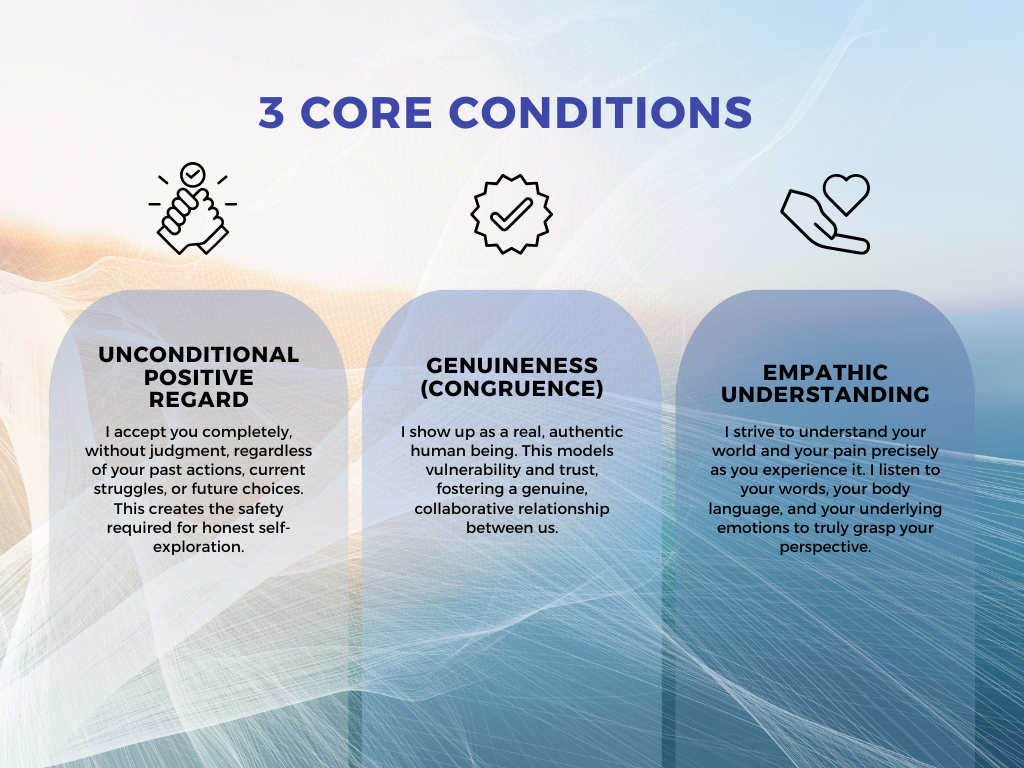
The three essential conditions of Person-Centered Therapy create safety and empower self-directed growth for adults in Little Rock navigating anxiety and life transitions.
Unconditional Positive Regard: I accept you completely, without judgment, regardless of your past actions, current struggles, or future choices. This creates the safety required for honest self-exploration.
Genuineness (Congruence): I show up as a real, authentic human being. This models vulnerability and trust, fostering a genuine, collaborative relationship between us.
Empathic Understanding: I strive to understand your world and your pain precisely as you experience it. I listen to your words, your body language, and your underlying emotions to truly grasp your perspective.
When these three ingredients are present, the client is empowered to make profound, self-directed changes.
3. Why PCT is Ideal for Life Transitions

Life transitions in Little Rock — including divorce, career shifts, and identity changes — require therapy that restores personal agency and clarity.
Life transitions—like divorce, job loss, or identity shifts—often make people feel powerless. PCT flips that script:
Reclaiming Agency: When the world feels out of control, PCT reinforces your personal agency: You set the pace.You choose the topic. You define success. This is incredibly stabilizing during chaotic times.
Holistic Integration: By honoring your unique narrative, we organically integrate the Mind, Body, and Spirit components of our holistic model, ensuring that the changes you make are authentic to your personal values and purpose.
Ready to Let Your Story Lead?
If you're seeking therapy that respects your autonomy, validates your experience, and trusts your inner wisdom, the Person-Centered Approach at BH Counseling Clinic is the perfect fit.
We are dedicated to providing client-led, accessible, holistic therapy to help Little Rock adults and families navigate change with clarity and self-confidence.
Your healing journey is unique, and it begins with your voice. Book your free 15-minute consultation today to start your story.
References
Rogers, C. R. (1961). On Becoming a Person: A Therapist's View of Psychotherapy.Houghton Mifflin.
Kirschenbaum, H., & Henderson, V. L. (Eds.). (1989). The Carl Rogers Reader. Houghton Mifflin.
American Psychological Association (APA) guidelines on ethical practice and client autonomy.